

When a Court Order Became a Suggestion: Contempt and the Opebi Estate After Injunction
Court orders are meant to be the final line between dispute and disorder. In the case of the late Madam Gbemisola Olabisi Gbolade-Odubona’s estate, that line was drawn clearly,and then repeatedly crossed.
In March 2025, the High Court of Lagos State issued a certified Order of Interim Injunction restraining any sale, advertisement for sale, demolition, construction, development, or act of ownership over the deceased’s estate, including the property at No. 75 (also referenced as 75B), Opebi Road, Ikeja. The order was explicit and unambiguous. It was intended to preserve the status quo pending the determination of ongoing proceedings.
What followed, according to petitions, correspondence, and visual evidence now in circulation, was not compliance but escalation.
Notice Given, Order Ignored
Evidence shows that the existence of the injunction was formally communicated to relevant parties, including the proposed buyer and state authorities.
Despite this, physical acts continued on the property.
Photographs and videos examined by Cry for Justice Nigeria show active demolition works at the Opebi site after the issuance of the injunction: walls broken, structures dismantled, and heavy equipment on site.
These were not preparatory acts carried out in ignorance of the law; they were overt exercises of ownership while litigation was ongoing!
From Private Defiance to State Complicity
Perhaps more troubling than private defiance is the appearance of state participation.
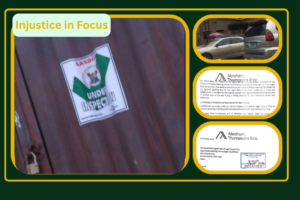
A Lagos State Building Control Agency (Lagos State Building Control Agency) “UNDER INSPECTION” seal was affixed to the gate of the Opebi property during the period covered by the injunction. The seal confirmed official presence and regulatory engagement.
Yet instead of enforcing the restraining order or halting activity, demolition reportedly continued between september 2025 and january 2026.
On 9th October 2025, after a LABSCA sealing for demolition without a permit by the porpoted buyer (Mr Seyi Oyetunde), the law firm of Abraham, Thompsons & Co. issued a formal Urgent Legal Notice and Protest to LASBCA. The letter expressly warned that:
•the property was subject to a subsisting court order;
•any approval, sealing, forfeiture, or demolition would amount to contempt of court;
•Lagos State lacked jurisdiction to authorise development or interfere with ownership; and
•any action taken would be null, void, and unlawful.
A certified true copy of the injunction was attached. The letter was acknowledged.
The activity on the property did not stop.
At that point, the issue ceased to be one of misunderstanding. It became one of institutional disregard for Judicial authority.
The Legal Meaning of What Happened
Contempt of Court is not a technical breach; it is a direct challenge to the authority of the Judiciary.
Where a court restrains all dealings with a property, no contract, permit, approval, or administrative process can lawfully override that restraint.
•Who authorised the continued works?
•On what documents were those authorisations based?
•Were officials aware of the court order when they acted?
•If so, why was the order ignored?
Either approvals were granted in ignorance, which suggests gross regulatory failure, or they were granted in spite of knowledge, which raises the spectre of deliberate contempt!
There is no third option!!
Professional Conduct Under the Shadow of an Order
Petitions further allege that legal practitioners continued to facilitate steps connected to the disputed property after the injunction had been issued. If established, this would raise serious professional questions.
Legal practitioners are officers of the court. They are not permitted to advise, facilitate, or legitimise acts that defeat a court order. Doing so undermines not only a specific proceeding but the entire Judicial system.
Beyond Opebi Road
What makes the Opebi case significant is not merely the family dispute that preceded it, but what followed after the court intervened.
Court orders are designed to cool disputes, not inflame them. When they are ignored with apparent impunity especially with visible state involvement the damage extends far beyond one property or one family.
It signals to the public that Judicial restraint is negotiable, and that power, paperwork, or influence can outpace the rule of law.
For the Late Madam Gbolade-Odubona, whose body remains unburied while her estate is dismantled, the injunction was meant to offer protection.
For Lagos State, the events that followed pose a more enduring question:
If a clear High Court order can be disregarded in plain sight, what remains of judicial authority when it is most needed?
To read the detailed story click here
This matter is subject to Judicial process. Reporting reflects publicly available records and does not imply guilt or liability.
Case Status:
Published: 04.01.2026
By: Cry for Justice Nigeria – ododo desk
SPOTLIGHT CASES

Cry for Justice Nigeria Impact & Accountability Framework
January 29, 2026

Bigger Picture: Rule of Law at Stake
January 29, 2026
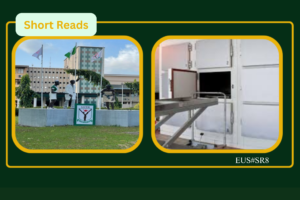
The Body Still in the Morgue
January 29, 2026

Lawyer Under Scrutiny
January 29, 2026